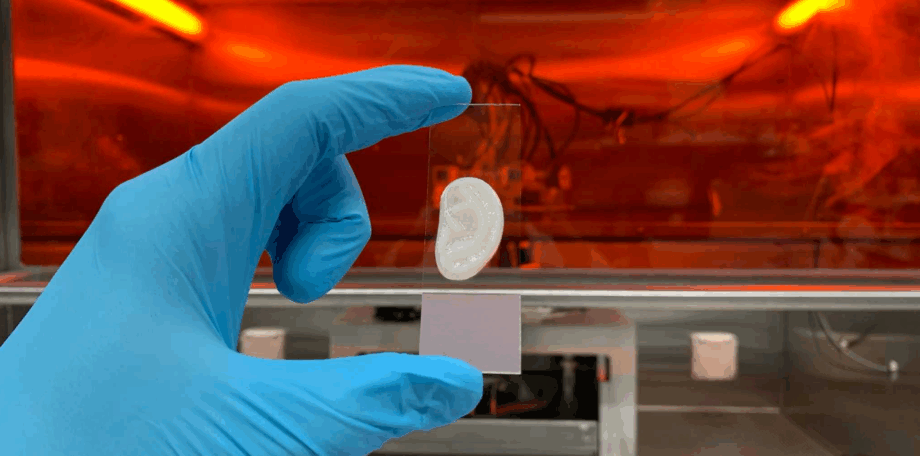
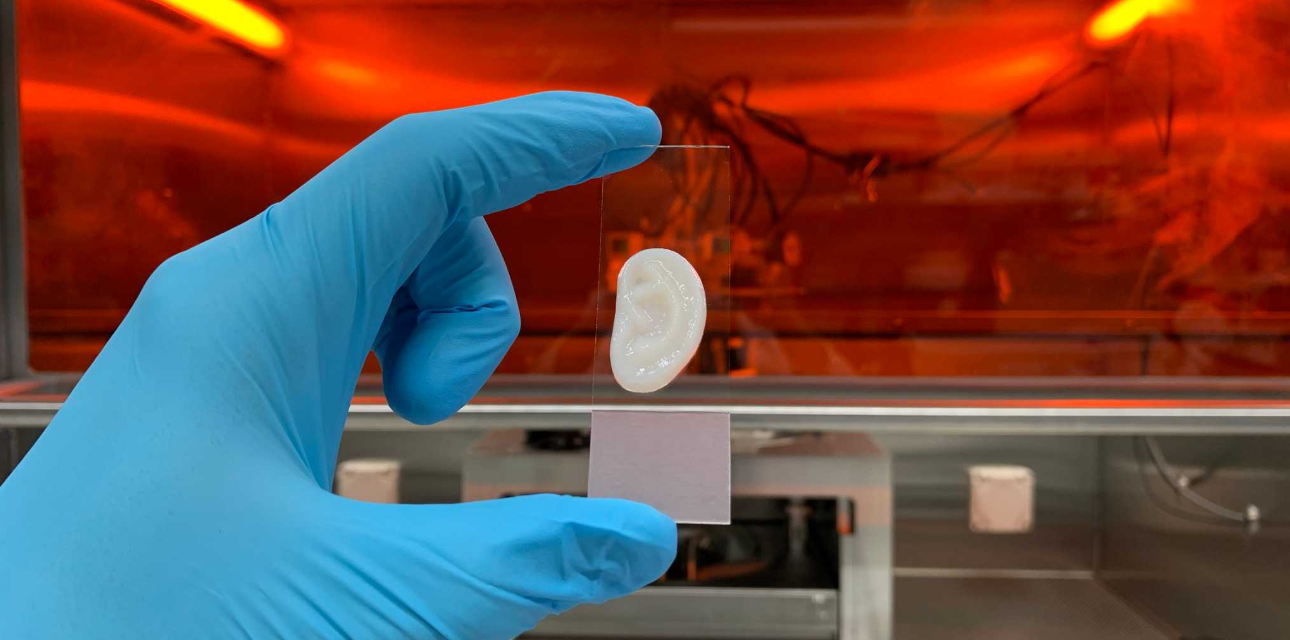

Researchers at ETH Zurich, the Friedrich Miescher Institute in Basel and the Cantonal Hospital of Lucerne have made an incredible step forward in 3D bio-fabrication. Their latest invention is a lab-grown ear cartilage made from human cells retaining its shape and elasticity in animal models. The project is based on the earlier work of the Tissue Engineering and Biofabrication Group, supervised by Professor Marcy Zenobi-Wong. Building on this research, the team developed engineered cartilage with mechanical properties that mimic natural ear tissue. After nine weeks of lab maturation and six weeks implanted under the skin of rats, the constructs remained dimensionally stable.
This breakthrough tackles a long-standing clinical challenge. Children born with microtia – the condition affecting around four in 10,000 births – and patients who lose ears due to injury typically undergo reconstruction with rib cartilage. That procedure can be painful and may produce tissue that is stiffer than a natural ear. “We aren’t implanting soft tissue in the hope that it remains stable in the body. Instead, we want to achieve that stability in the laboratory,” said Philipp Fisch, lead author of the study detailed in Advanced Functional Materials.
The team began with small cartilage samples and expanded roughly 100,000 harvested cells into the hundreds of millions needed for 3D printing. The cells were embedded in a gel-like bio-ink and printed into 3D structures using a 3D printer. The team optimized four crucial factors: cell proliferation, material properties, cell density, and the maturation environment. Researchers aimed to promote type II collagen, elastin, and glycosaminoglycans, all key components of resilient cartilage, and avoid fibrocartilage formation.
Elastin is still the missing piece. “Despite this major success, elastin remains a challenge for us, as we were not able to mature it fully,” Fisch said. According to the scientists, it might take them up to five more years to identify the biological “blueprint” for a stable elastin network. “Our current study provides a good guide to the current state of research,” he concluded, “It shows how close we already are to recreating the human ear – and what’s still missing.”