
Summary
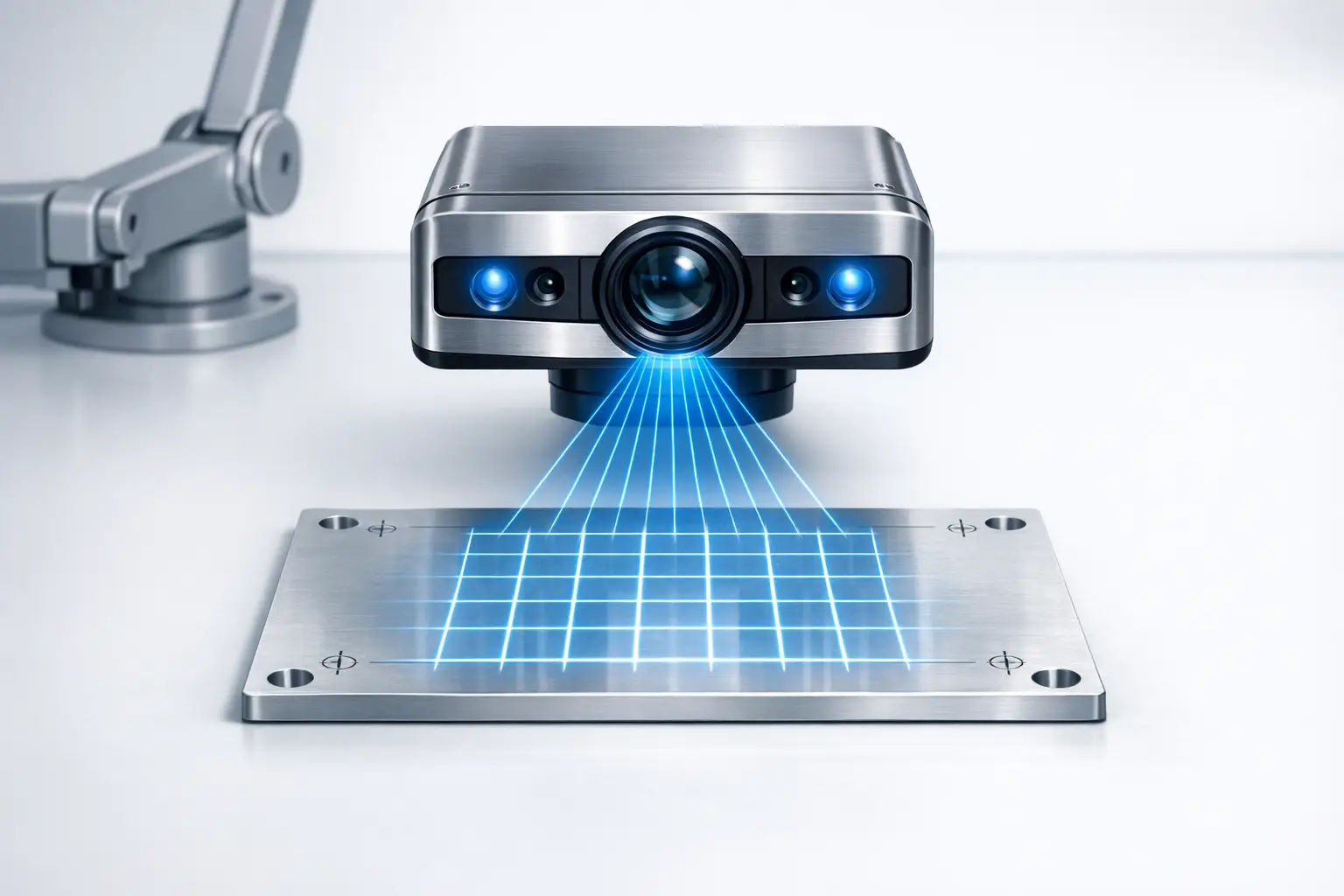
3D scanner types encompass several core technologies — laser triangulation, time‑of‑flight, phase‑shift, and structured‑light. Each type is distinguished by key performance metrics, notably accuracy, speed, and effective scanning range. Modern structured‑light scanners can deliver planarity better than 0.01 mm, while handheld laser and long‑range phase‑shift devices fill other precision and range niches. [1][2][3]
Historical Background
The technological roots of 3D scanning lie in the development of laser measurement systems and optical triangulation in the late 20th century. Early laser triangulation devices were commercialized in the 1980s, with companies like Cyberware contributing major advances, while time‑of‑flight systems are traced to Light Detection and Ranging (LiDAR) principles developed at NASA in the 1960s. These foundational technologies enabled increasingly precise digital mapping of physical objects, leading to the diverse 3D scanner types seen today. No reliable figure found for the exact names of the first inventors or a precise launch year of the first commercial scanner.
Technical Principles
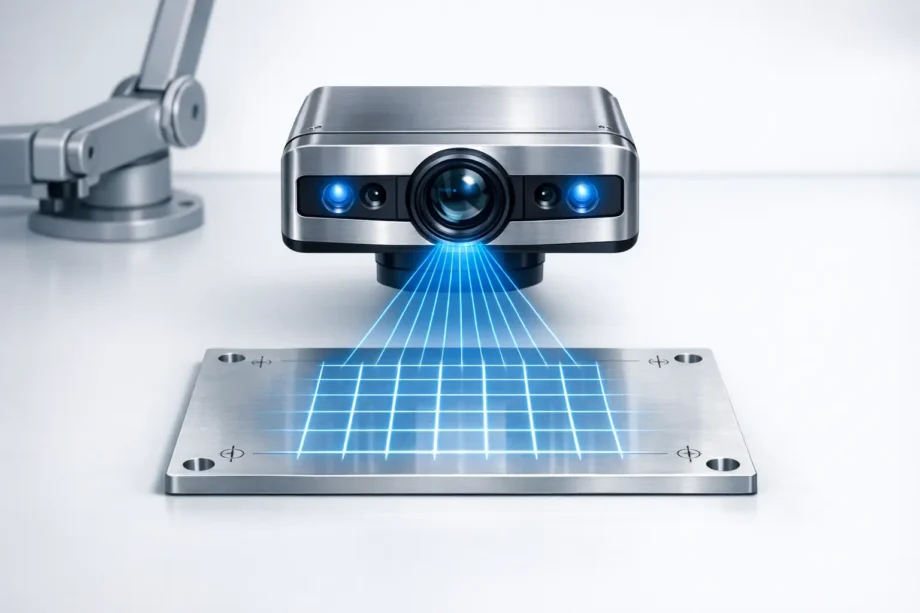
Structured‑light and laser-based scanners — especially triangulation, time‑of‑flight, and phase‑shift — all use optical measurement for 3D capture, but differ in how they resolve distance and object shape. [1][4]
Accuracy is quantified by individual scan point errors (single‑scan accuracy) and cumulative error across larger areas (volumetric accuracy). For structured‑light scanners, planarity of a two-foot-wide surface can achieve 10 µm, and vertical elevation errors as low as 2 µm have been recorded in dense calibration scenarios. Handheld laser triangulation devices like the Artec Point document up to 0.02 mm single‑scan accuracy and can process up to 2.8 million points per second. Time‑of‑flight and phase‑shift scanners are tuned for larger working distances, with ranges reaching 1 000 m and 150 m respectively — corresponding accuracy at those ranges is typically in the 1–6 mm domain. [1][2][3][4][5]
Types of Scanners
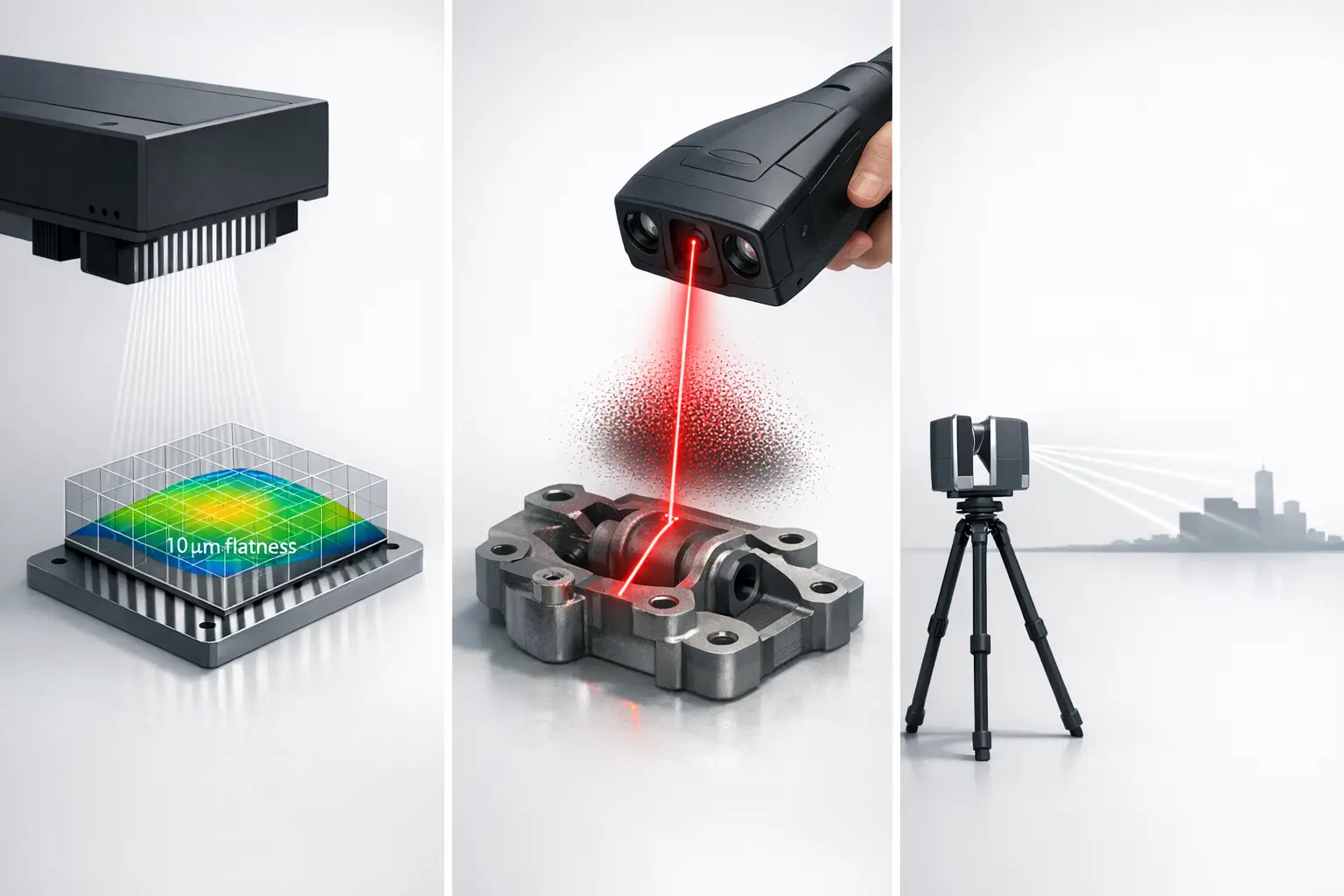
The principal 3D scanner types include laser triangulation, structured‑light projection, time‑of‑flight, and phase‑shift systems.
Short-range scanners, especially structured‑light and triangulation models, offer impressive resolution and scan speed. For instance, structured‑light scanners can digitize areas up to 48 inches wide, produce up to 16 million points per scan, and achieve point spacing of 16 µm and planarity to 10 µm. Leading handheld units, such as Artec Eva, deliver scan speeds up to 2 million points per second at 0.1 mm accuracy and 0.5 mm resolution. [1][3][6][8]
- Advantages:
- Exceptional fine detail for small objects and components
- Fast scanning cycles (as little as two seconds)
- Portable, suitable for on‑site use
- Minimal post-processing for small volumes
Mid‑ and long‑range scanners — primarily time‑of‑flight and phase‑shift models — are engineered for large environments. Time‑of‑flight scanners can measure up to 1 000 m with 3–6 mm accuracy, ideal for geospatial mapping, while phase‑shift designs offer slightly better accuracy (1–3 mm) and faster throughput (over 1 million points per second) with typical ranges up to 150 m. As a reference, the Artec Ray achieves a working distance of 110 m with sub‑millimeter (0.7 mm) accuracy for large-scale digitization. [4][5][9]
Comparison Table of Scanner Types:
| Scanner Type | Typical Range | Accuracy | Points per Second | Primary Application |
|---|---|---|---|---|
| Structured‑light | <1 m–2 m | 0.01–0.1 mm | up to 16 million | Small parts, reverse eng. |
| Laser triangulation | <1 m | up to 0.02 mm | up to 2.8 million | Industrial, handheld |
| Time‑of‑flight | Up to 1 000 m | 3–6 mm | ~500 000–2 million | Architectural, survey |
| Phase‑shift | Up to 150 m | 1–3 mm | >1 million | Construction, mapping |
| Artec Ray (example) | Up to 110 m | 0.7 mm | n/a | Building, heritage |
Performance Comparison
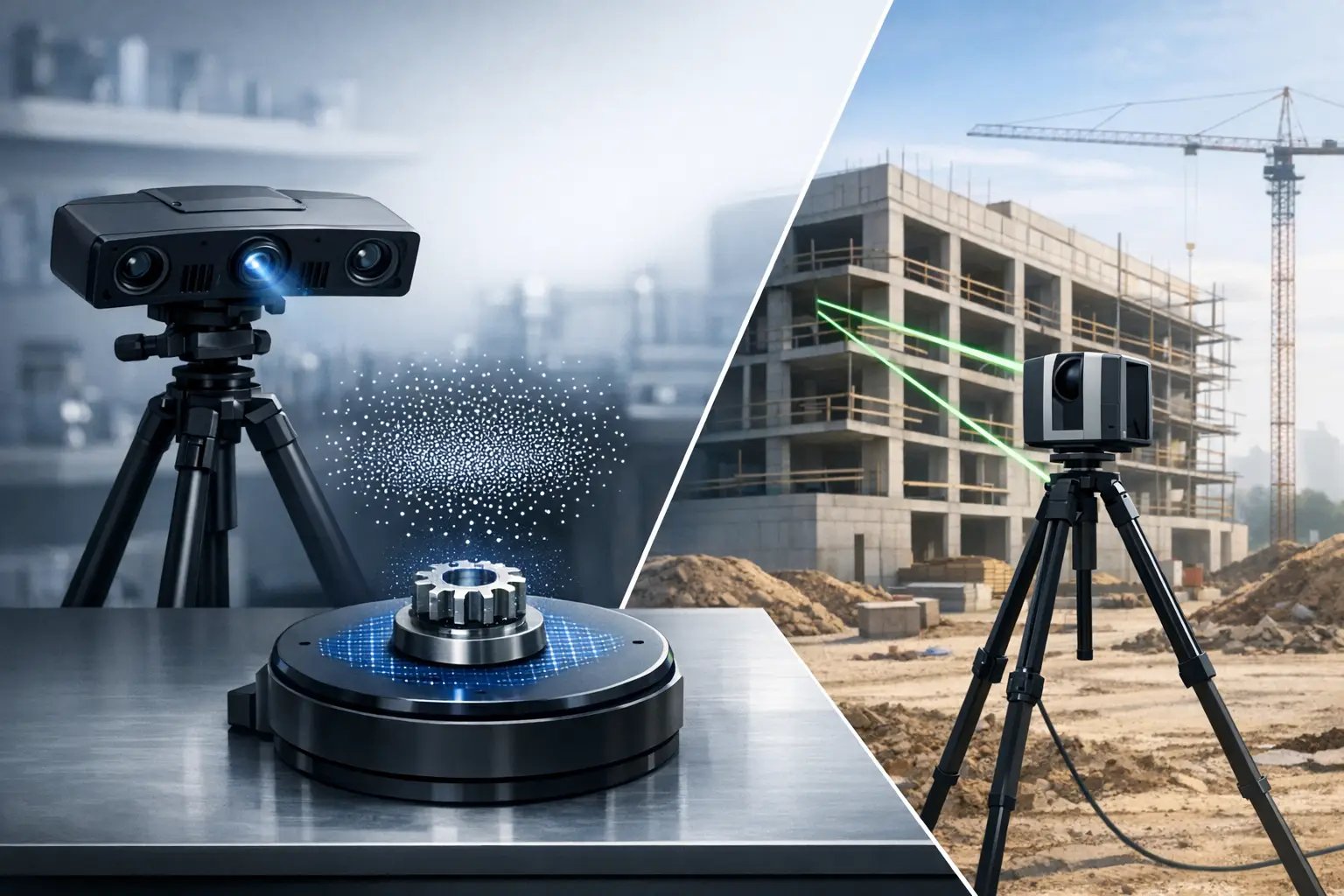
Comparing scanner types reveals distinct performance trade‑offs. Structured‑light systems boast the finest detail — planarity errors under 10 µm and vertical elevation accuracy down to 2 µm — excelling in small object digitization and inspection. High-end devices such as Artec Point surpass 0.02 mm accuracy with exceptionally dense point clouds, whereas handheld structured‑light models like Artec Eva achieve 0.1 mm accuracy at up to 2 million points per second. For larger environments, time‑of‑flight scanners dominate with 1 000 m range but at reduced accuracy (3–6 mm), while phase‑shift systems offer a middle ground—up to 150 m at 1–3 mm, processing over 1 million points per second. Comparison tables are essential for evaluating these parameters because they quickly illustrate the accuracy–range–speed trade-offs, supporting informed scanner selection for diverse tasks. [1][2][3][4][5][6][7][8][9]
Applications
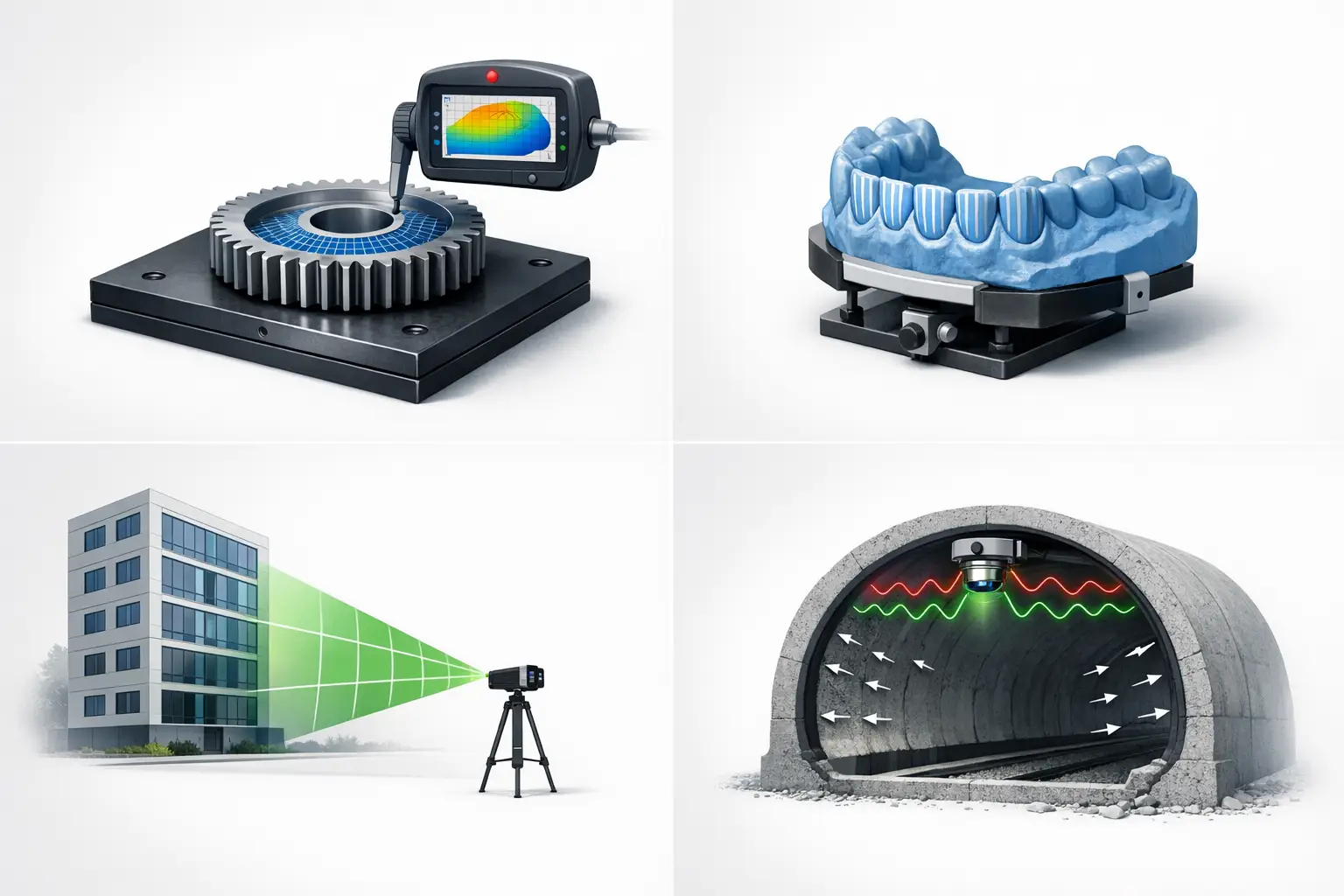
Different 3D scanner types cater to specific industries: structured‑light and laser triangulation are pivotal in industrial metrology, quality control, rapid prototyping, and medical customizations due to their precision. Time‑of‑flight and phase‑shift technologies are valued in surveying (land, building, tunnel), construction documentation, and large cultural heritage preservation projects. Handheld devices enable on‑site reverse engineering and digital archiving with speed and portability. [1][3][4][6]
Some niche applications demand distinct capabilities — for example, micro-structured‑light scanners for dental impression digitization, and phase‑shift systems for real‑time infrastructure deformation tracking during civil engineering works.
Research Updates
Recent 3D scanning research explores improvements in light-encoding patterns and multi-scale neural network fusion (e.g., Multiscale Convolutional Neural Networks, MSCNN) to boost surface reconstruction fidelity and real-time scanning speed. Other work involves dynamic light‑section encoding for motion robustness, and hybridization of structured‑light with stereo-photogrammetry. However, no reliable figure found in the fact pack for quantitative advances such as exact accuracy improvements or commercial readiness—many advances are pre‑market or remain described in academic preprints.
Q&A (FAQ)
1. What are the main 3D scanner types?
The principal types are laser triangulation, structured‑light, time‑of‑flight, and phase‑shift 3D scanners. [1][4]
2. How accurate are structured‑light 3D scanners?
High-end structured‑light scanners can achieve planarity errors as low as 10 µm over a 2-foot surface and vertical accuracy (elevation) of 2 µm. [1][2]
3. What ranges can time‑of‑flight scanners cover?
Time‑of‑flight scanners can operate up to 1 000 m with typical accuracy between 3–6 mm. [4]
4. How is volumetric accuracy different from single‑scan accuracy?
Single-scan accuracy indicates local error for one scan—e.g., 0.05 mm—while volumetric accuracy describes error accumulation with size, typically worsening (e.g., by 0.15 mm per meter). [7]
5. (Expert) What is the point‑per‑second throughput of Artec Point and how does it compare to phase‑shift systems?
Artec Point reaches up to 2.8 million points per second, while phase‑shift scanners usually manage over one million points per second. [3][5]
6. (Expert) Why should an article include a comparison table when discussing accuracy vs. range?
Tables let users quickly evaluate how accuracy, range, and speed differ between scanner types, ensuring clear, standardized technology selection. [4][5]
Sources
- Structured-light 3D scanner – Wikipedia
- Structured-light 3D scanner – Elevation example, Wikipedia
- Laser 3D scanner – Triangulation accuracy and Artec Point, 3D Mag
- Time-of-flight and phase-shift systems, 3D Mag
- Phase-shift scanner performance summary, 3D Mag
- Structured-light performance, EMS-USA
- 3D scanner accuracy and resolution basics, Aniwaa
- Artec Eva – Accuracy and resolution, Artec 3D (Wikipedia)
- Artec Ray – Range and accuracy, Artec 3D (Wikipedia)