
Summary
The Artec Leo and Artec Ray II complementary bundle provides a full-scope 3D scanning solution for accident reconstruction. Leo excels at capturing high-resolution detail with up to 0.1 mm accuracy, while Ray II covers entire scenes with long-range LiDAR and 1.9 mm accuracy at 10 meters. Their combined scanning speeds reach millions of points per second, enabling efficient documentation of complex accident scenes. [1][2]
Historical Background
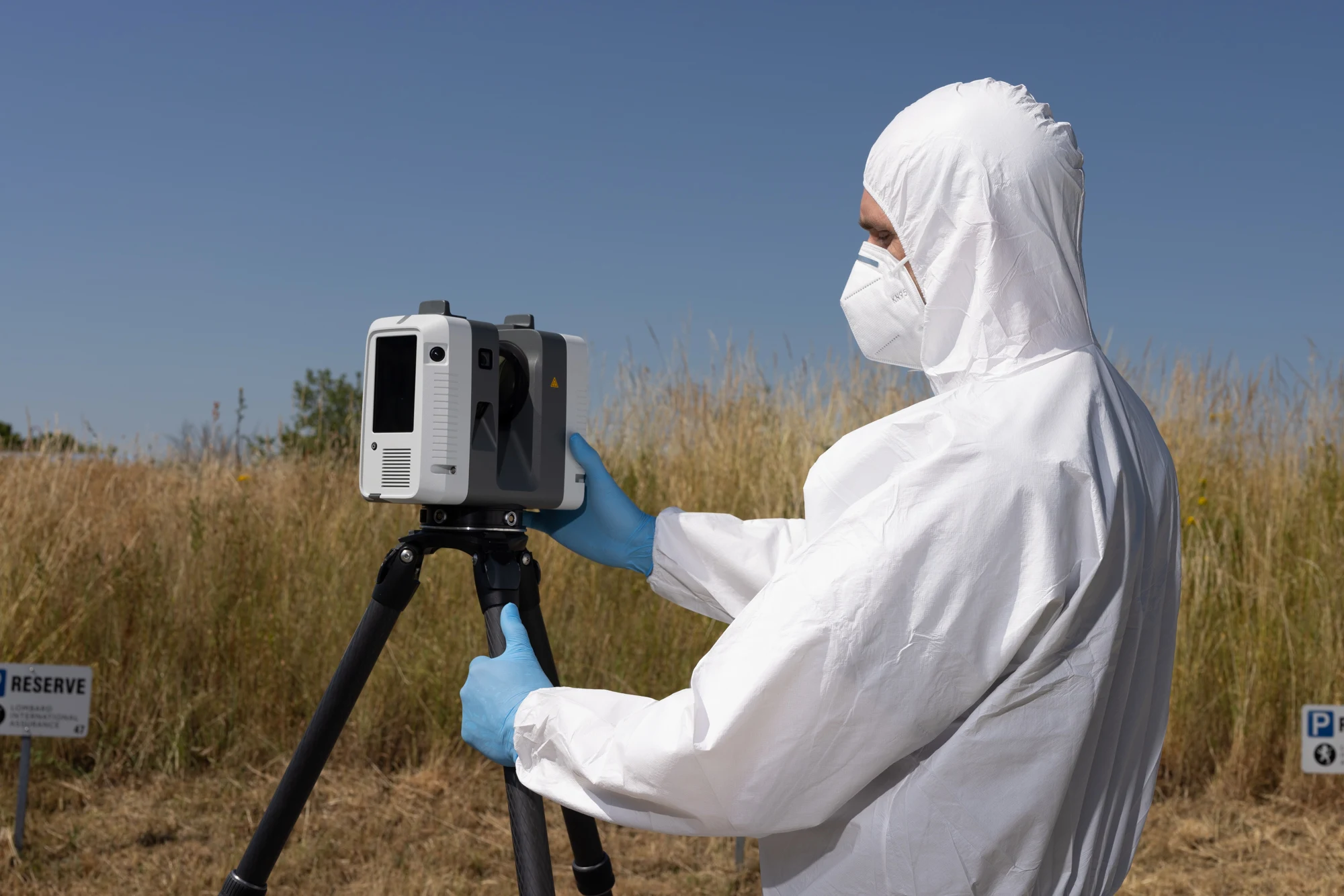
Artec Leo, launched around 2018, marked a significant advancement in handheld structured-light 3D scanning, offering onboard computing and cable-free operation for digitizing detailed evidence in forensic and accident scenarios. The Artec Ray II, developed in collaboration with Leica Geosystems, was designed to scan large areas and objects — such as vehicles or crash scenes — using precision long-range LiDAR. This technology supports accident investigators with rapid, accurate scene capture, as demonstrated in high-profile applications like the 3D documentation of a Luxembourg Air Rescue helicopter, which showcased the speed and completeness achievable with the two-scanner approach. [3][4][5]
Technical Principles
The Artec Leo operates as a handheld structured-light scanner, projecting a VCSEL pattern while capturing surfaces with onboard software powered by an NVIDIA Jetson TX2. Its real-time data fusion and cable-free operation enable high-mobility scans at incident sites. [1]
The Ray II employs long-range time-of-flight LiDAR combined with visual imaging sensors (VIS), offering autonomous tripod deployment and remote Wi-Fi operation. The laser sensor achieves a 3D point accuracy of 1.9 mm at 10 m, selectable resolution down to 3 mm at similar distances, and a maximum effective range of 130 m — suited for both localized vehicle mapping and expansive multi-object scenes. The system’s rapid acquisition rate of up to 2,000,000 points per second enables large accident reconstruction tasks to be completed in hours rather than days. With angular accuracy specified at 18 arcseconds (0.87 mm at 10 m), Ray II provides the spatial fidelity needed for registering and aligning scene data layers, ensuring both global and local accuracy for forensic analysis. [6][7][8][9]

Performance
The Artec Leo achieves a 3D point accuracy of up to 0.1 mm, with a geometric resolution of 0.2 mm, translating to the ability to document even subtle surface features such as scratch patterns or minor deformations. Its data acquisition speed reaches up to 35 million points per second in HD mode, and it operates effectively at working distances of 0.35–1.2 m. This level of performance supports the rapid, detail-rich scanning essential for collision damage assessment and physical evidence documentation. [1][2][3][4]
The Ray II delivers 1.9 mm point accuracy at 10 meters, with three configurable resolutions (3, 6, or 12 mm at 10 m), a scan rate of 2,000,000 pts/s, a working range from 0.5 to 130 m, and angular accuracy of 18″ (0.87 mm at 10 m). [5][6][7][8][9]
Leo vs Ray II Comparative Table
| Feature | Artec Leo | Artec Ray II |
|---|---|---|
| Point Accuracy | up to 0.1 mm | 1.9 mm @ 10 m |
| Resolution | up to 0.2 mm | 3, 6, 12 mm selectable @ 10 m |
| Capture Speed | up to 35M pts/s | up to 2M pts/s |
| Working Distance / Range | 0.35 – 1.2 m | 0.5 – 130 m |
| Angular Accuracy | not specified | 18″ (0.87 mm @ 10 m) |
| Typical Reconstruction Use | Fine surface/detail | Large scene, global registration |
Applications
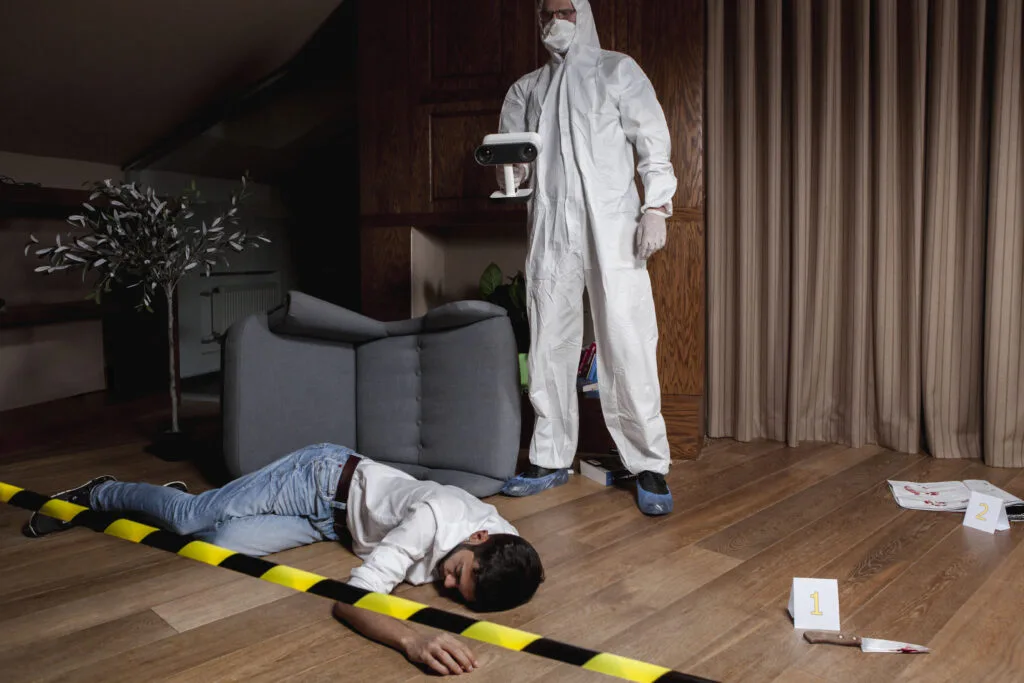
Combined, the Artec Leo and Ray II streamline digital capture for accident reconstruction, facilitating workflows that reduce on-site scene documentation times — as illustrated in the less-than-11-hour scan of a full-sized helicopter. This integration enables both detailed close-up geometry (dents, tool marks, trace evidence) and broader context (vehicle trajectories, debris fields). [5]
Applications include:
- Vehicle accident scenes
- Crime scene documentation
- Infrastructure collision analysis
- Forensic reconstructions
- Aircraft and train crash sites
Typical workflow:
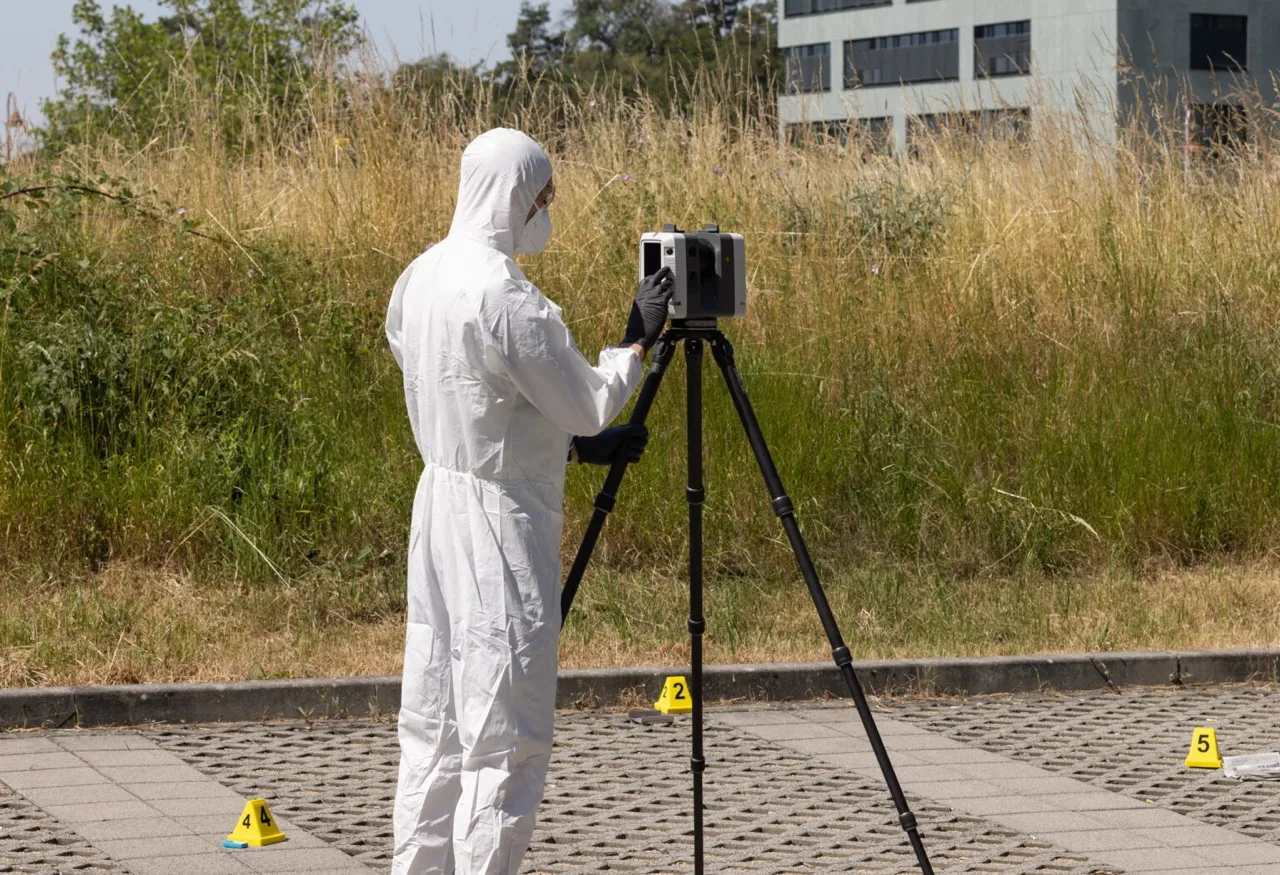
- Deploy Ray II on tripod for site-wide scan and evidence geometry.
- Scan vehicles, small objects, or accident artifacts up-close with Leo.
- Merge scans in Artec Studio software.
- Export high-resolution 3D models for analysis or courtroom presentation.
Research Updates
Notable research use cases, such as the Luxembourg Air Rescue helicopter scan, demonstrate the practicality of the Leo and Ray II bundle for thoroughly documenting large complex objects in limited time. In these scenarios, users integrated data using Artec Studio’s Smart Fusion mode, which rapidly aligns datasets from both scanners, optimizing for accuracy and workflow efficiency. No peer-reviewed scientific benchmarks were found to independently validate manufacturer claims, but industry deployments highlight robust field performance. [5]
FAQ
1. What is the point accuracy of the Artec Leo for accident reconstruction?
Artec Leo provides up to 0.1 mm 3D point accuracy, allowing for precise capture of collision details. [1]
2. How far can the Artec Ray II scan, and what accuracy does it provide at long distances?
Ray II can scan up to 130 m, delivering 1.9 mm point accuracy at 10 m distance. [5][8]
3. How do the terms accident reconstruction 3D scanner apply to the Leo & Ray II bundle?
The bundle pairs Leo’s handheld capture for fine detail with Ray II’s long-range scene documentation, supporting comprehensive accident reconstruction data collection.
4. What scanning resolution and speed are achievable for detailed dent mapping?
Leo can achieve 0.2 mm 3D resolution with acquisition rates up to 35 million points per second, enabling detailed dent and deformation documentation. [2][3]
5. Expert: How should one calibrate and recalibrate the Artec Leo for maximum precision in varying temperature conditions?
Leo supports user-guided recalibration via Artec Studio. For maximum accuracy in fluctuating temperatures, perform recalibration in the working environment before scanning, following software-guided prompts for optimal results (per manufacturer guidance).
6. Expert: How does angular accuracy of 18″ (0.87 mm @ 10 m) in Ray II affect alignment of scene segments in layered scanning?
Ray II’s high angular accuracy ensures layers of large scene scans align precisely, minimizing registration error when combining multiple vantage points or integrating Leo close-ups. [9]
Related on 3D Mag
Sources
- Artec Leo 3D scanner — Specifications
- Artec Leo technical details
- Artec Leo data capture speed reference
- Artec Leo working distance reference
- Luxembourg Air Rescue helicopter case study
- Artec Ray II specifications (CADTech USA)
- Artec Ray II resolution options
- Artec Ray II range and speed specification
- Artec Ray II angular accuracy and Leica collaboration
- Artec Leo & Ray II hail inspection case (background info)