
Summary
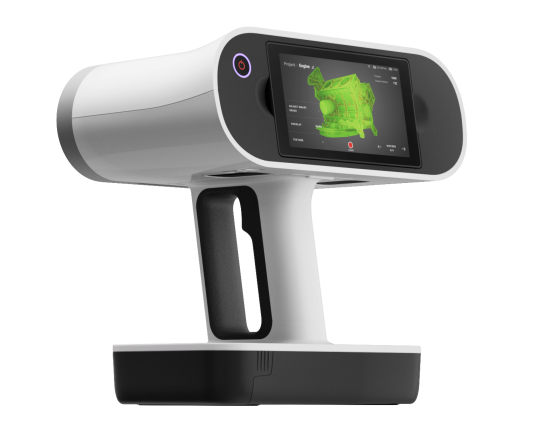
This article provides a technical overview of using the bundle Artec Leo and Artec Ray II for hail damage inspection. Combining the high-precision Artec Leo handheld 3D scanner and the long-range Artec Ray II enables both fine surface defect detection and rapid, large-area scanning. The Leo excels at capturing detailed hail-induced dents with up to 0.1 mm accuracy, while the Ray II contextualizes damage patterns at the vehicle scale. Their complementary capabilities, point resolutions, and implementation workflow provide an efficient two-tiered approach for comprehensive automotive hail damage assessments. [1][2][5]
Historical Background
The Artec Leo, released in 2018, was the industry’s first wireless handheld 3D scanner offering onboard data processing. The Artec Ray II, a long-range tripod-based laser scanner, followed as a solution for large-area, high-speed 3D surveys of vehicles and infrastructure surfaces. [7][5]
Technical Principles
Artec Leo utilizes structured light from a VCSEL (Vertical-Cavity Surface-Emitting Laser) array combined with onboard NVIDIA Jetson TX2 processing power. This integration supports a scanning resolution of up to 0.2 mm and point accuracy of up to 0.1 mm—vital for inspecting small dents and surface deviations from hail. The onboard processing, HD mode, and fast real-time visualization allow scanning professionals to quickly digitize automotive panels without external computers. The Leo achieves a data acquisition speed of up to 35 million points per second, with an optimal working distance of 0.35–1.2 meters, enabling rapid, high-precision surface scanning. [1][2][3][4]
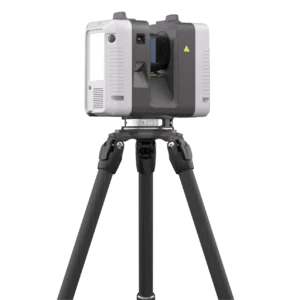
Artec Ray II operates as a long-range laser scanner, specialized for covering extensive areas efficiently. It provides 1.9 mm point accuracy at 10 meters and selectable point spacing—3, 6, or 12 mm at 10 meters—enabling swift acquisition of overall vehicle geometry and damage context. [5][6]
Types and Performance
Artec Leo and Artec Ray II differ in both hardware and measurement paradigms. The Leo offers fine-resolution scanning (0.2 mm) and high accuracy (up to 0.1 mm), making it ideal for detailed mapping of hail dings and subtle surface disruptions. Its close-range, handheld operation suits localized inspections, with a typical capture volume of 160,000 cm³ per scanning session. In contrast, the Ray II, with a much broader range and 1.9 mm accuracy at 10 meters, excels in quick surveys of large objects like whole vehicle bodies, providing lower resolution data (down to 3–12 mm per point at range) but excellent contextual mapping. The Ray II is deployed when rapid data acquisition of the entire hood, roof, or side panel is necessary before selecting smaller areas for Leo’s higher-detail passes. Data acquisition speed and mobility set Leo apart, whereas spatial coverage is the Ray II’s strength. Together, their bundled use supports an efficient workflow for both surface detail and broader shape assessment in hail damage scenarios. [1][2][3][4][5][6]
| Feature | Artec Leo | Artec Ray II |
|---|---|---|
| Max Point Accuracy | Up to 0.1 mm | 1.9 mm @ 10 m |
| Resolution | Up to 0.2 mm | 3/6/12 mm @ 10 m |
| Max Volume/Pass | 160,000 cm³ | Large vehicle-scale (multi-m²) |
| Speed | Up to 35 M points/s | Rapid area coverage |
| Working Distance | 0.35–1.2 m | 0.5–130 m (manufacturer model) |
When bundled, the two systems allow inspectors to first use Ray II for fast context capture, and then deploy Leo to measure and verify individual hail dent depths and dimensions with sub-millimeter reliability.
The bundle thus combines detailed dimple mapping (Leo) and overall panel deformation analysis (Ray II), greatly enhancing both thoroughness and efficiency in automotive insurance and repair assessments. [1][5]
Applications
A typical hail damage inspection workflow with the Artec Leo and Artec Ray II bundle consists of several steps. Inspectors begin with the Ray II, quickly capturing the entire vehicle to document the distribution of hail impacts and to identify areas needing closer examination. The Artec Leo follows, providing high-resolution surface maps of the hood, roof, and door panels, revealing dents as small as sub-millimeter in scale—well within the Leo’s 0.1 mm accuracy and 0.2 mm resolution specifications. This dual approach reduces scanning and post-processing time while ensuring that each panel’s minute features are quantitatively assessed for repair or insurance purposes. [1][2][5]
Inspection steps typically include:
- Deploying Artec Ray II for vehicle-wide context scans.
- Reviewing scan data to flag areas with likely hail-induced deformation.
- Using Artec Leo for rapid, close-range acquisition of affected panels or zones.
- Exporting and analyzing 3D data to measure dent sizes and depths for reporting.
Research Updates
No reliable figure found for published peer-reviewed studies or extensive manufacturer-validated whitepapers on the use of the Artec Leo and Ray II bundle specifically for automotive hail damage inspection; field validation with sample vehicles is recommended for prospective users.

FAQ
1. What is the best 3D scanner for hail damage — Artec Leo?
The Artec Leo is widely regarded as the optimal choice for hail dent measurement due to its 0.1 mm geometric accuracy and 0.2 mm resolution, providing reliable, repeatable results on fine surface details. [1][2]
2. How accurate is Artec Leo for hail dent measurement?
Artec Leo achieves up to 0.1 mm point accuracy, with resolution up to 0.2 mm—allowing inspectors to detect and quantify even the smallest hail dings on automotive panels. [1][2]
3. When should I use Artec Ray II in hail damage inspection?
Use the Artec Ray II for rapid, full-vehicle surveys to document hail damage spread and panel alignment. Its 1.9 mm accuracy and large-area coverage make it suitable for detecting broader surface distortions and triaging sections for Leo’s high-detail scans. [5][6]
4. What scanning distance provides optimal hail dent resolution?
For highest fidelity dent capture, the Leo should be held within its working range of 0.35–1.2 meters from the surface. Scanning closer to the lower end of this range maximizes detail detection in dimpled bodywork. [4]
5. How to bundle Artec Leo and Artec Ray II workflows?
Begin with Ray II to rapidly scan the entire vehicle for context and damage mapping. Import the data into inspection software, select regions of damage, then use Leo for focused, high-resolution 3D scans of those zones. Correlate and cross-reference data layers for robust reporting. [1][5]
6. What resolution and speed should I prioritize for hail damage inspection?
Prioritize sub-millimeter resolution (0.2 mm or finer) for detailed dent detection—Artec Leo delivers this. For fast documentation of large surfaces, Ray II’s area coverage with selectable resolution is preferred, supplemented by high-speed Leo scans for close inspection. [2][3][6]